A sauna is not a hot room.It's a discipline.
Every retreat we build follows Finnish sauna standards - the accumulated judgment of the culture that invented the sauna and never stopped refining it.
A tradition older
than the country.
The sauna predates Finland itself. The earliest smoke saunas - savusaunas - appeared around 1000 CE: a wooden room, a mound of stones over fire, no chimney. The smoke cured the walls; the stones held the heat for hours.
Chimneys arrived in the 16th century, metal stoves in the 19th, electric heaters in the 1950s. The technology changed; the principles didn't. What worked was kept. What didn't quietly disappeared.
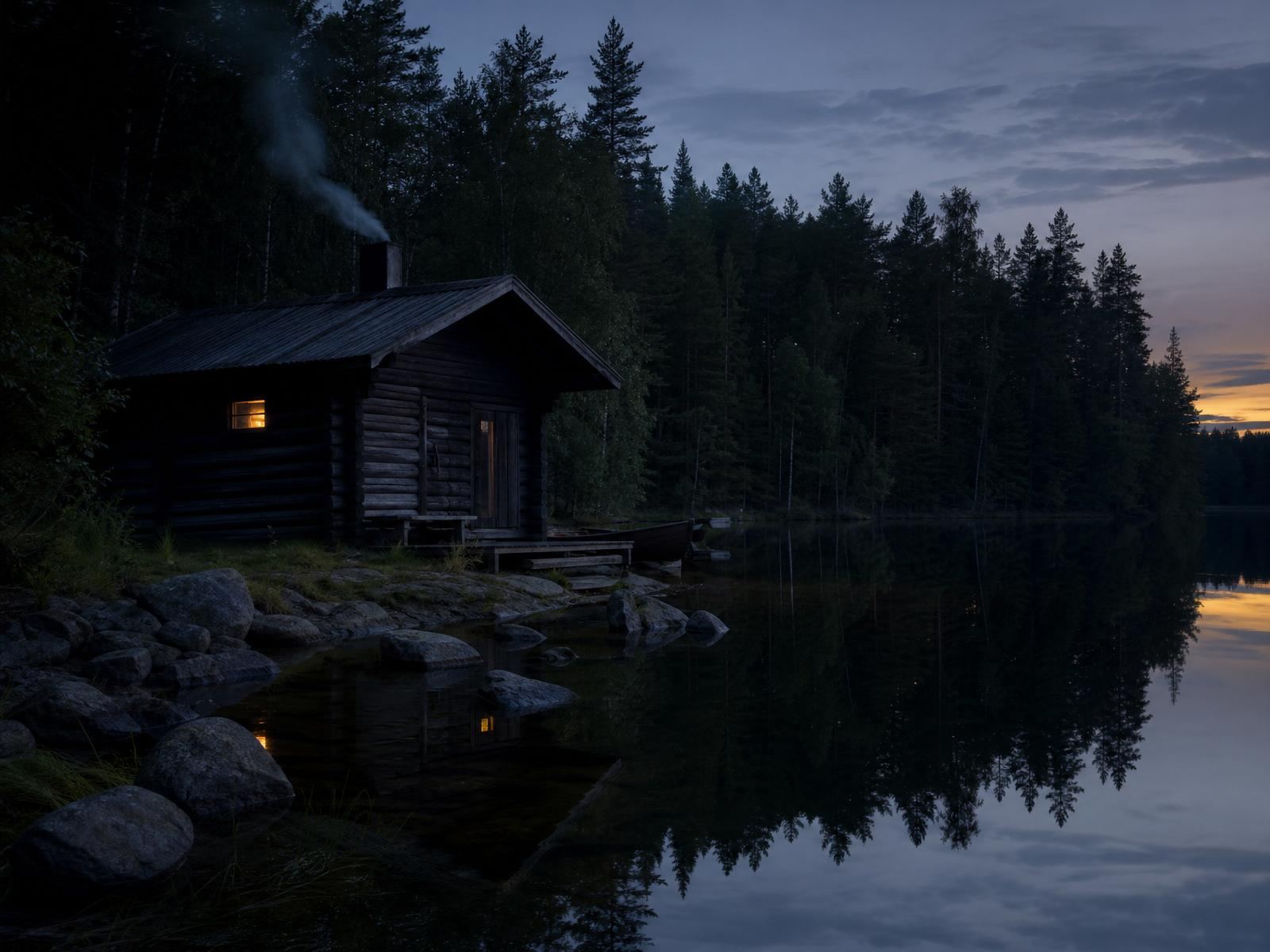
Finns were historically born in the sauna and washed there for their last rites. Today Finland has roughly three million saunas for five and a half million people.
In 2020, UNESCO inscribed sauna culture in Finland on its Representative List of the Intangible Cultural Heritage of Humanity - the first Finnish tradition so recognized. UNESCO described the sauna as a sacred space, a "church of nature," with löyly - the steam released when water meets hot stone - at the heart of the experience.
“When we say we build to Finnish standards, we mean we build inside that tradition - not beside it.”
What the standards
actually say.
Five principles that separate a sauna from a room that resembles one. Each one is measured, documented, and older than most of the buildings around it.
Air that moves.
Finnish guidance has called for the air in a sauna to be exchanged three to six times every hour for over half a century. Fresh supply enters above the heater; a mechanical exhaust draws air out below the foot bench - the arrangement Finland's technical research institute VTT has recommended since 1992. It's why a real sauna feels fresh at 90 degrees while a sealed box feels suffocating at 70.
Feet above the stones.
Pälsi's Law - the First Law of Löyly, recorded in 1961 and written into Finland's RT building guidance - holds that a bather's feet on the foot bench should sit at or above the top of the heater's stones, keeping the whole body inside the warm convective zone. No cold feet. No scorched head.
The Rule of 230.
Finnish tradition works from a ceiling height of roughly 230 centimeters - the baseline from which bench tiers, heater clearances, and heat stratification all resolve at once. Most North American builds start a foot too low and compromise everything above the shoulders.
Stone mass, not element heat.
The stones make the löyly, not the heater. A properly sized stone mass turns thrown water into soft, enveloping steam rather than a harsh flash of humidity.
Built for the freeze.
Vapor sealing, insulation, and drying ventilation detailed for a climate of hard winters and hundreds of freeze-thaw cycles - the climate the standards were written in, and the climate we build in.
Baltic January,
Georgian Bay January.
A January beside the Baltic and a January beside Georgian Bay are close cousins - deep cold, heavy snow, five months of damp air pressing on a small heated building. A standard engineered for Finnish winters isn't overkill in the snowbelt; it's the minimum.
Helsinki
60°N- Winter length
- ~5 months
- Annual snowfall
- ~65 cm
- Freeze-thaw cycles
- Hundreds / yr
Collingwood
44°N- Winter length
- ~5 months
- Annual snowfall
- ~275 cm
- Freeze-thaw cycles
- Hundreds / yr
- 3–6 × / hour
- Air fully exchanged
- 230 cm
- The working ceiling height
- 1961
- Pälsi's Law recorded
- 2020
- UNESCO inscription
The whole ritual.
In Finland, the sauna was never a single room - it was a sequence.
- 01
Heat
The sauna, built to the standard above.
- 02
Cold
A sunken plunge, plunge tub, or the bay itself.
- 03
Rinse
An outdoor shower for before and between rounds.
- 04
Comfort
A proper washroom, so the ritual never sends anyone back to the house.
- 05
Rest
The fireside lounge and kitchenette, where the evening actually happens.
- 01
Heat
The sauna, built to the standard above.
- 02
Cold
A sunken plunge, plunge tub, or the bay itself.
- 03
Rinse
An outdoor shower for before and between rounds.
- 04
Comfort
A proper washroom, so the ritual never sends anyone back to the house.
- 05
Rest
The fireside lounge and kitchenette, where the evening actually happens.
The standards govern the hot room, but the tradition is the full circuit - heat, cold, rest, repeat - which is why we design complete retreats rather than standalone boxes.
About the standard itself.
Are Finnish standards a legal requirement here?
No; Ontario's building code governs the structure, but nothing here requires a sauna to actually work as a sauna. The Finnish standards are the discipline we hold ourselves to voluntarily - and the reason our retreats feel the way they do.
What is löyly?
The steam that rises when water is thrown on hot stones - and, to Finns, the spirit and quality of that steam. Everything in Finnish sauna design exists in service of good löyly.
Can an authentic Finnish sauna be modern?
Yes. Authenticity is about principles - air, stone, heat, proportion - not nostalgia. Finland's own certification body recognizes thoroughly contemporary saunas, provided the fundamentals are honoured.
Built to the standard.
Shaped to your lifestyle.
No obligation. We reply within two business days.
Plan Your Retreat