Most home exercise spaces fail for the same reason: they were designed as storage for equipment rather than as places a person wants to be. The treadmill in the unfinished basement, the mat rolled up behind the guest room door - these are good intentions without architecture. A movement studio inside a health pavilion takes the opposite approach. It starts with a simple question: what kind of room would pull you in every day?
Light is the whole design
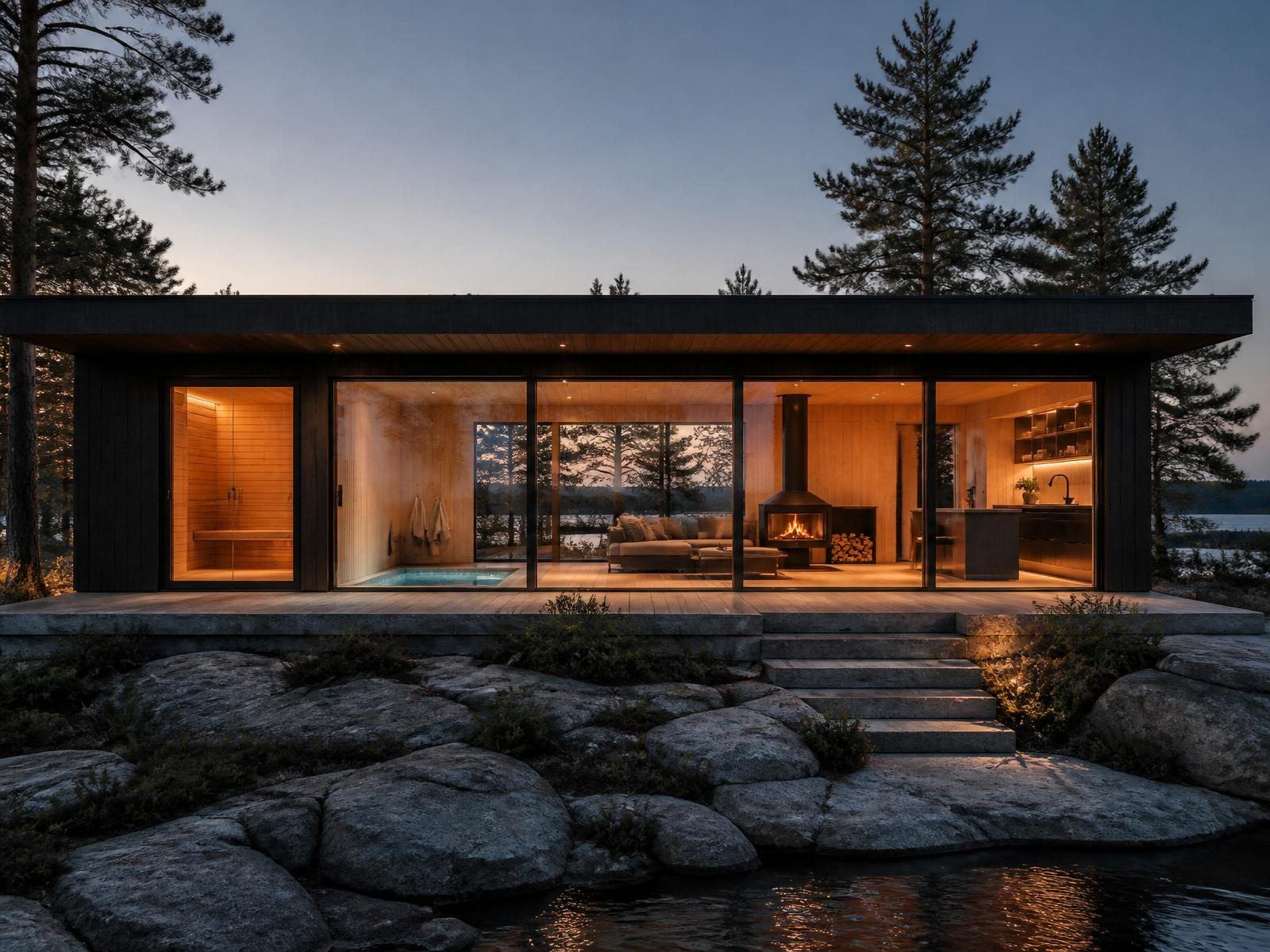
Ask anyone who practises regularly what makes a great studio and the answer is almost never equipment. It's light. A room with generous glazing - ideally facing the landscape rather than the driveway - changes the experience of every session. Morning sun on the floor in January is reason enough to unroll the mat. In this region, where the escarpment, the hardwood bush, or the bay itself is often the view, the studio becomes a way of practising in the landscape while staying warm, which matters from November through April.
Floor-to-ceiling glass on one wall, a solid wall for inversions and mirror work opposite, and you have the bones of a room that works as hard in February as it does in June.
The floor, the air, the quiet
The details that separate a studio from a spare room are physical. A proper sprung or engineered wood floor is warm underfoot, kind to joints, and makes everything from sun salutations to strength work feel better. Radiant in-floor heat is worth every dollar in a Georgian Bay winter - a warm floor at 6:30 a.m. removes the biggest excuse in the coldest months. Ventilation deserves equal attention: a room where the air stays fresh through a hot flow or a hard interval session is a room you'll return to.
And then there's sound, or the absence of it. Part of the pavilion's logic is separation from the main house. No dishwasher running, no household traffic, no one wandering through. Twenty minutes of genuine quiet is increasingly the rarest amenity in any home.
One room, many practices
Call it a yoga studio, but design it as a movement room. The same open floor handles mobility work after ski days, strength training with minimal equipment, physio exercises during a rebuild, meditation, and - with a screen or simply a laptop - the virtual classes and remote instructors that now make elite coaching available anywhere. Built-in storage keeps mats, blocks, weights, and bands invisible until needed, so the room always resets to calm.
Its position within the pavilion multiplies its use. Warm tissue stretches better, so the studio-to-sauna adjacency isn't a convenience - it's a protocol. Practice, heat, plunge, lounge: the full circuit lives under one roof.
The social studio
Here's the underrated part: a beautiful studio is a gathering space. Private instructors will come to you - and in this area, many of the best already spend their days driving between clients' homes. A Saturday morning small-group class with four friends, followed by coffee in the lounge, is the kind of standing ritual that makes a pavilion the centre of a social life rather than a solitary one. Wellness in this region has always been communal; the chairlift and the group ride prove it. The studio simply brings that instinct home.
The best studio is not the one with the most equipment. It's the one you walked into this morning without thinking about it - because the room itself made the decision easy.
Thinking about where a studio would sit on your property? Orientation and sightlines are everything - it's the first thing we look at on a site visit.