Barrel Saunas vs. Cabin Saunas: What Happens in a Collingwood Winter?
Temperature is the number everyone checks. It is the number printed on the listing, the number on the dial, and on its own it tells you very little.
A room can read 85°C and still be a bad session. Air temperature is a single-point reading taken at one height, often near the ceiling or the heater. It tells you very little about how the rest of the room is performing.
Three things decide that. How evenly the heat is distributed. What the steam is like when you pour. And whether any of that survives a night when it is minus twenty outside.
That last one is the whole game up here.
Fit is invisible in the store
Anyone who has skied knows this one. Rental boots are built to fit the average of everyone. Wide enough for wide feet, soft enough for beginners, and slightly wrong for every person who puts them on. A bootfitter heats the shell and molds it to the shape of your actual foot. Same object. Completely different day.
A sauna can be the same. The dimensions look right, the heater is rated for the volume, and the photographs show a beautiful wooden room. You only discover how it actually performs once you sit in it, pour water, and try to stay comfortable for a full session.
Many saunas reach temperature and are still difficult to sit in for more than five minutes. Stale air, harsh steam, your head is hot and your feet are cold. You feel hot…but also uncomfortable and it's not okay.
Evenness
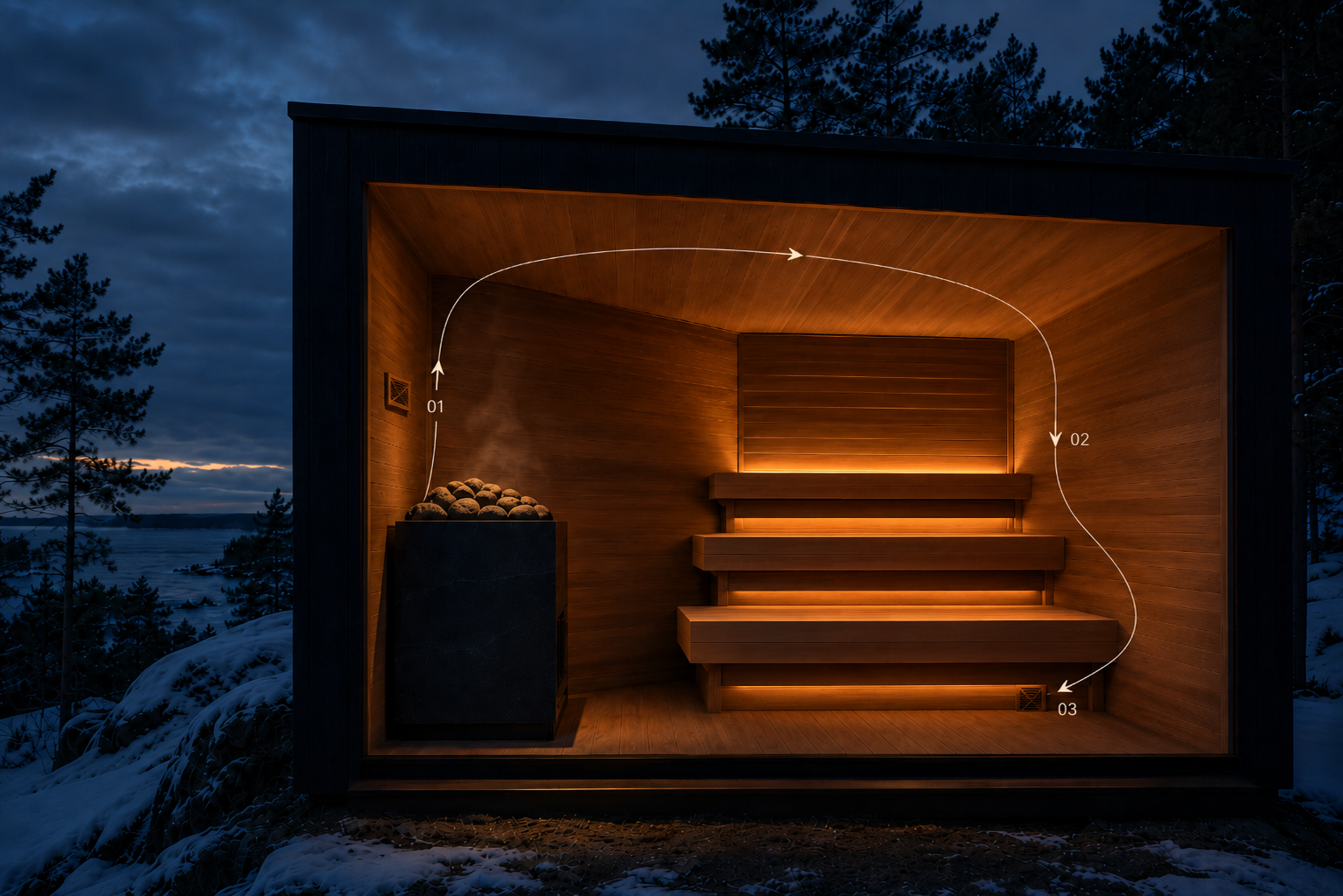
Heat stratifies. Hot air rises, and every sauna has a temperature gradient from floor to ceiling. Good design accounts for that gradient instead of leaving the seating area wherever the available space happens to allow.
Bench height determines where your body sits within the heat. Heater selection and ventilation influence how air gets circulated. Insulation and glazing affect how much heat escapes and how stable the environment is throughout the session.
A poorly insulated wall or a large area of unsuitable glazing can create cold surfaces that pull heat from you, even while the air around your head feels hot. Cold air always wins.
The thermometer says the sauna is working. Your body disagrees, and your body is correct. You start to shift around, move your feet, lean forward, sit back. Nothing is obviously wrong, but you cannot quite settle into the session.
Steam
Löyly is the steam and heat sensation produced when water meets the hot stones. It is a defining part of the traditional Finnish sauna experience, and its performance depends on the heater, the stones, and the room around them.
Stone mass provides thermal reserve. More stones can store more energy and release it as water is poured, although heater design, stone temperature, element power, and recovery time all matter….a lot. A smaller heater can produce excellent löyly when properly matched to the room. A larger stone-mass heater can offer a more substantial reserve for repeated pours.
The difference becomes apparent over the course of a session. You pour, feel the heat rise, let it pass, and pour again. A well-designed sauna and heater recovers predictably. You can settle into a rhythm without wondering whether the next ladle will feel the same.
Bench layout determines how that rising heat reaches you. Ventilation controls oxygen, carbon dioxide, and humidity levels in the room. The system removes stale air without creating uncomfortable drafts or excessive heat loss.
A good heater can still disappoint in a room with poor design, poor airflow, or an envelope that loses heat faster than the system can comfortably replace it.
Then it gets cold
Here is the part that turns all of this from a quality argument into a functional one.
Heat loss increases as the temperature difference between inside and outside grows. A sauna at 85°C with 10°C outside is maintaining a 75-degree difference. At −25°C, that difference is 110 degrees. The same room is now losing substantially more heat through its walls, roof, floor, and glazing.
If the building envelope is weak or the heater has been selected without accounting for that load, the result is longer warm-up times, cold surfaces and uneven temperatures. Most importantly, slower recovery between pours.
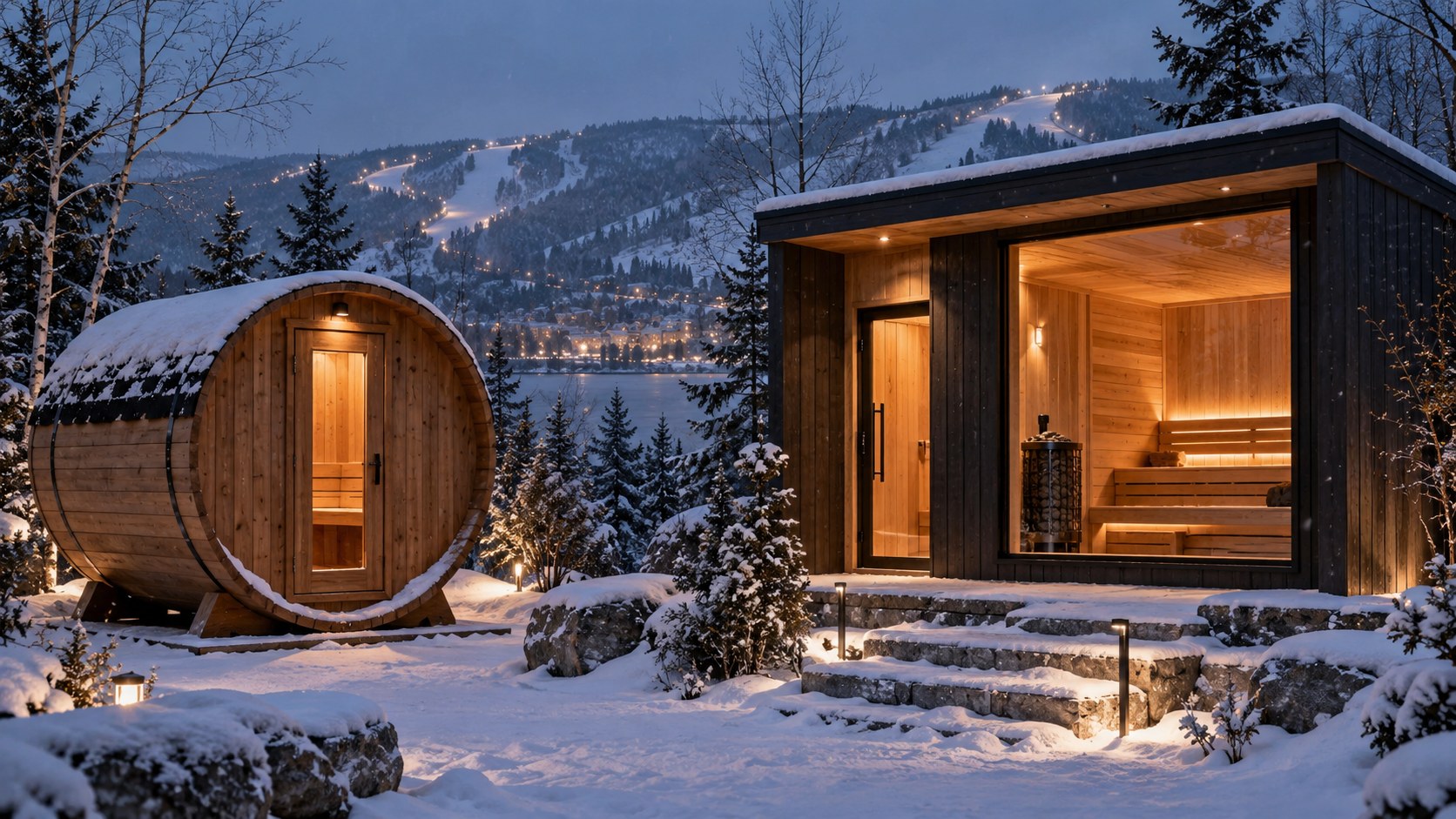
A thin-walled barrel or lightly built kit may perform acceptably in autumn and struggle in deep winter. Some uninsulated models rely almost entirely on the thickness of their wooden staves to separate the hot room from the outdoors. The heater has to make up for every watt escaping through that envelope.
At some point, it may spend most of the session running at full output. The room takes longer to heat up and recover after the door opens or fresh air enters.
Construction quality, heater selection, ventilation, glazing, and bench geometry determine the result.
A sauna intended for Collingwood or the Blue Mountains should be designed around the experience and conditions it will actually face, including the coldest days of the year.
The benefit of a sauna lives in frequency. A comfortable, reliable sauna becomes part of your routine.
The part that makes this decision different
You can replace boots that do not fit. You can trade the car.
A sauna sits on a pad you poured, with a 240V run from your panel that an electrician charged you for. It is in the sightline from your kitchen window and it may be there in fifteen years. Upgrading can mean demolition and a second start.
So if you are not certain you want a sauna practice, a kit is an honest way to find out. Some people discover they wanted the idea more than the thing, and there is nothing wrong with that.
But if you already know, build for February.
Build for the hundredth session, on the coldest night of the year. Think about where your feet will be, how the air will move, what happens after the third pour, and how much heat the room will lose when the temperature outside drops to minus twenty-five.
Those details decide whether the sauna becomes a regular part of your life, or something you only use when the weather is easy.
We design and build custom saunas, cold plunges and health pavilions across Collingwood, Blue Mountain, the Beaver Valley and Southern Georgian Bay. If you're weighing up a build, we're happy to walk the property with you first.