The Air in the Room: Why Ventilation Separates a Real Sauna from a Hot Box
There's a moment every experienced sauna-goer knows. You step into an unfamiliar sauna - a hotel gym, a rental cottage, a friend's new backyard kit - and something is off. The thermometer says 85 degrees, the wood looks right, the heater is humming. But the air feels heavy. Ten minutes in, you're not relaxed; you're vaguely dizzy, a little anxious, watching the door. You leave early and blame yourself for being tired.
You weren't tired. You were breathing your own exhaust.
The invisible ingredient
In Finland, ventilation isn't an accessory to sauna design - it's close to the whole point. Finnish building guidance has, for over half a century, called for the air in a sauna to be fully exchanged roughly three to six times every hour. Think about what that means: the entire volume of the room, replaced every ten to twenty minutes, continuously, while you bathe. Not a gap under the door. Not a vent you crack open afterward to dry things out. A designed, deliberate flow of fresh outdoor air moving through the hot room the entire time you're in it.
The reason is simple biology. A sauna is a small, sealed, hot space occupied by people breathing hard. Carbon dioxide accumulates fast, and elevated CO2 is precisely what produces that heavy, stifling, get-me-out-of-here feeling that so many North Americans assume is just "what saunas are like." It isn't. A properly ventilated sauna at 90 degrees feels easier to breathe in than a poorly ventilated one at 70. Finnish researchers at VTT, the state technical research centre, have studied this since the early 1990s, and their findings match what any Finn could tell you by feel: fresh air is what makes long, comfortable, repeated sessions possible.
Ventilation also shapes the löyly - the steam that rises when water hits the stones. Good airflow carries each wave of steam through the room and then clears it, so humidity returns to baseline and the next ladle lands just as softly as the first. Without it, moisture and heat stack up near the ceiling in a stagnant layer: scorching at head height, cold at your feet, harsh instead of enveloping.
Where most manufacturers go wrong
Here is the uncomfortable truth about much of what's sold as a "sauna" in this country: it's a well-insulated room with a heater in it. Many prefab kits and barrel saunas ship with no engineered ventilation at all, or with a token pair of vents placed where physics guarantees they do nothing.
The most common mistakes are predictable. Both vents placed low, so air short-circuits across the floor without ever reaching the breathing zone. An exhaust in the ceiling, which does move air - by dumping your heat and steam straight outside, killing the löyly you just paid for. Or the classic: no intake at all, on the theory that a sauna should be "sealed tight to hold the heat." VTT's research demonstrated decades ago that these passive arrangements simply don't work in electrically heated saunas. The room gets hot, the air gets stale, and the owner quietly stops using it after the first winter.
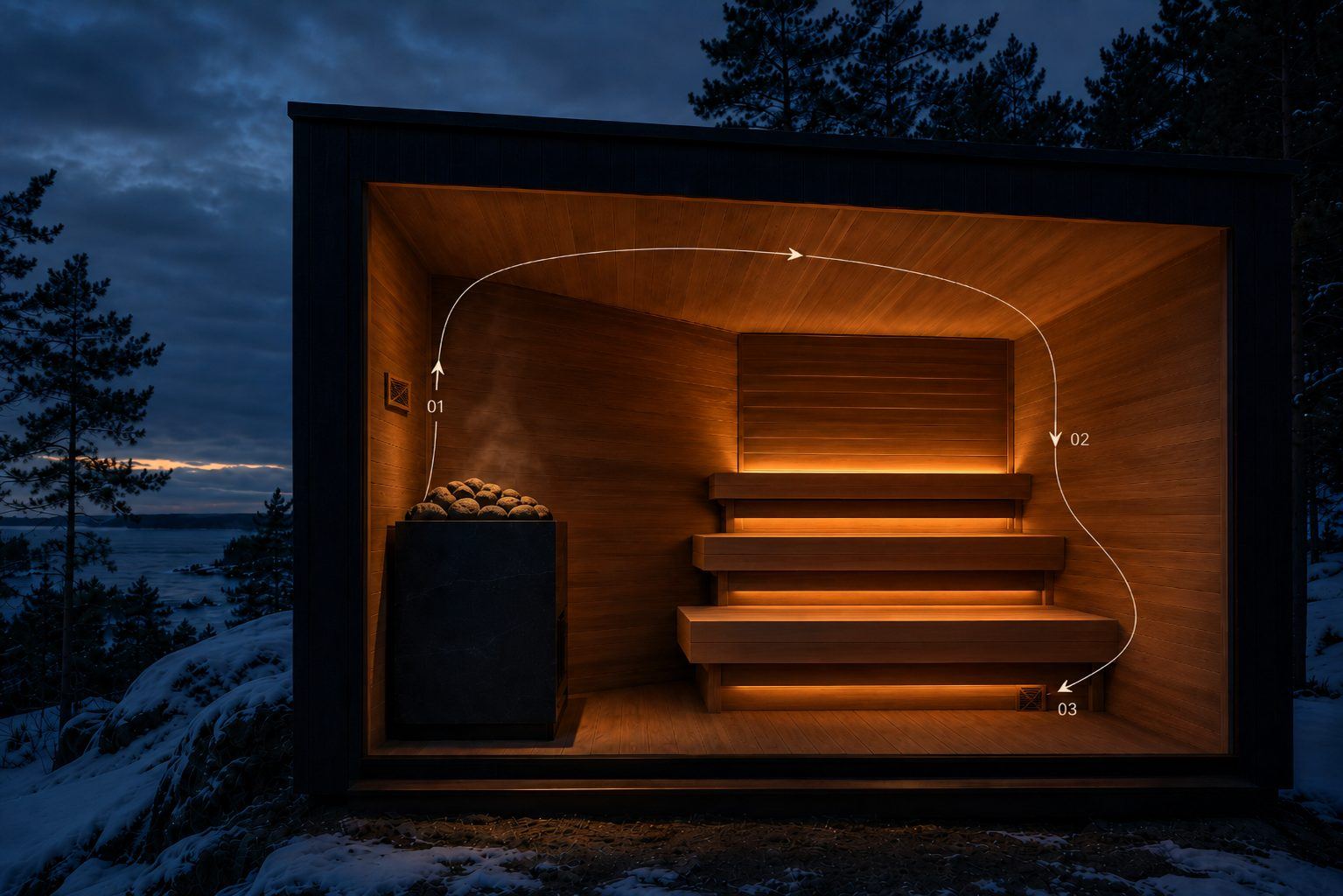
What works - and what better Finnish builders have specified since the nineties - is almost counterintuitive: fresh air enters above the heater, where it gets swept into the rising convective loop and distributed through the whole room, and a mechanical exhaust pulls air out below the foot bench on the opposite wall. This "downdraft" arrangement draws warm air down past the bathers, which does three things at once: it keeps CO2 at healthy levels where people are actually breathing, it dramatically evens out the temperature from ceiling to floor (warm feet, at last), and it keeps the benches hot enough for basic hygiene. It's a small fan and two well-placed openings - and it is the difference between a sauna you endure and a sauna you return to nightly.
Why this matters when you're buying
Ventilation is nearly invisible on a spec sheet, which is exactly why it gets skipped. Heater wattage, wood species, and glass doors photograph well; a duct behind a cedar grille does not. But if there is one question that instantly reveals whether a builder understands saunas, it's this: how is the ventilation designed, and where does the fresh air come in? A serious builder will answer in detail. A kit reseller will change the subject.
And here's the part that makes Finnish standards more than a nice import: they were written for a climate that looks remarkably like ours. A January in Helsinki and a January in Collingwood are close cousins - weeks below freezing, heavy snow, and cold, damp air pressing against a small heated building for five months of the year. Finland sits beside the Baltic; we sit beside Georgian Bay, with the lake-effect snowfall to prove it. Both places share the punishing rhythm that ventilation rules were built to survive: a room that swings from minus twenty to plus ninety and back, saturated with steam in between, through hundreds of freeze-thaw cycles a season. When Finnish building guidance insists on continuous air exchange, it isn't fussiness - it's what carries moisture out of the structure after every session, protecting the wood, the insulation, and everything you've built around it. A sauna standard engineered for the Finnish winter isn't overkill in the snowbelt. It's the minimum.
The Finns settled this question generations ago: a sauna is not a hot room. It's a hot room that breathes. Everything we build starts from that principle - because the difference isn't visible in a photo, but you'll feel it in the first ten minutes, every single time.